Category: Industry Playbooks

Practical, sector-by-sector guides to what AI automation actually changes in a Singapore business.

  • AI Automation for GP Clinics in Singapore: The 2026 Playbook

    AI Automation for GP Clinics in Singapore: The 2026 Playbook

    Singapore’s GP and medical clinics run on tight margins and even tighter front-desk headcount. A solo practice or small group clinic often has one or two staff juggling phone calls, WhatsApp enquiries, walk-ins, and appointment changes at the same time, while patients increasingly expect the instant, 24/7 responsiveness they already get from e-commerce and food delivery apps. This playbook covers where AI automation delivers the fastest return for a Singapore clinic, the data-privacy and clinical-safety guardrails that apply, how much of the cost is grant-fundable, and what a typical Stack AI clinic engagement looks like.

    “Patients increasingly expect the instant, 24/7 responsiveness they already get from e-commerce and food delivery apps — not a phone line that’s busy until 9am.”

    Where Clinics Lose the Most Time

    Front-desk teams at Singapore clinics tend to lose time to the same handful of repetitive, high-volume tasks:

    Pain Point Typical Impact
    Repetitive WhatsApp/phone enquiries (hours, doctor availability, walk-in wait, directions) Front-desk staff interrupted dozens of times a day; slower service for patients physically in the clinic
    Appointment booking and rescheduling handled manually Double-bookings, long hold times, no booking capacity outside clinic hours
    No-shows Empty slots, lost revenue, no consistent reminder cadence
    Post-visit follow-ups (medication reminders, review bookings, chronic-disease check-ins) Inconsistent follow-through and missed repeat-visit revenue
    Claims and billing admin (insurance, Medisave, corporate panels) Manual data entry and delayed reimbursement

    What Stack AI Can Automate for a Clinic

    Stack AI automation is designed to sit alongside a clinic’s existing Clinic Management System (CMS), including systems on MOH’s CMS Tiering Framework for Primary Care, rather than replace it. Automation connects to the existing patient records and booking system via API, so a clinic does not need to switch CMS vendors to benefit. Typical automation covers:

    A 24/7 WhatsApp or website chat assistant that answers FAQs, checks appointment availability, and books or reschedules directly into the clinic’s existing calendar or CMS.

    Automated appointment reminders (WhatsApp/SMS) with two-way confirm-or-cancel replies, which is the single fastest way most clinics cut no-shows.

    Post-visit follow-up sequences, covering medication reminders, review-visit scheduling, and chronic-condition check-ins, that run automatically instead of relying on staff to remember.

    Pre-visit intake automation, collecting patient forms and history digitally before the patient arrives.

    Claims and billing admin automation, capturing structured data and routing it to reduce manual entry for insurance and corporate-panel claims.

    Internal operations support, including automated end-of-day appointment summaries, staff scheduling reminders, and stock reorder alerts for consumables.

    Data Privacy and Clinical Safety: The Non-Negotiables

    Healthcare automation carries a different risk profile than a retail or F&B chatbot. Every clinic automation project Stack AI scopes is built around a few non-negotiables, before a single workflow is written:

    PDPA compliance for patient data handling, with clear consent capture at first contact.

    No AI-generated clinical advice or diagnosis. The assistant handles scheduling, logistics, and FAQs, and hands off to clinical staff for anything involving symptoms, results, or treatment.

    Human-in-the-loop escalation for any message a patient flags as urgent, or that the AI cannot confidently resolve.

    Alignment with MOH and HSA’s AI in Healthcare Guidelines (AIHGIe 2.0, refreshed March 2026), which set expectations for transparency, risk mitigation, and defined responsibilities between developers, deploying clinics, and clinicians.

    Funding Your Clinic’s Automation Project

    Most clinic automation projects Stack AI builds, including WhatsApp assistants, reminder systems, and intake and billing automation, qualify as pre-approved or custom digital solutions, making them fundable the same way as other Singapore SME automation projects:

    Grant What It Covers Funding
    PSG (Productivity Solutions Grant) Pre-approved, off-the-shelf automation tools: chatbot platforms, scheduling, invoicing Up to 50%, capped at S$30,000 per company per financial year
    EDG (Enterprise Development Grant) Custom, multi-function automation built around the clinic’s specific workflows Up to 50% of qualifying consultancy and development cost
    Enterprise Innovation Scheme Tax deduction on qualifying automation spend, on top of grant funding 400% tax deduction

    Ready to see what’s fundable?

    We grant-pre-check every clinic automation project before a contract is signed.

    Book a Free Call

    How a Clinic Automation Project Works

    1. Discovery call: walk through the current booking flow, CMS/software stack, and where staff time is actually going.

    2. Scope the highest-impact automation first, usually WhatsApp booking plus reminders, since it deploys fastest and shows ROI within weeks.

    3. Grant pre-check: confirm whether the project maps to a PSG pre-approved category or needs EDG scoping, before any contract is signed or payment made.

    4. Build and connect: integrate with the existing CMS/calendar via API, and configure escalation rules and PDPA-compliant consent flows.

    5. Staff walkthrough and soft launch: the front-desk team is trained, and the assistant handles a subset of enquiries alongside staff.

    6. Full rollout and monitoring: track no-show rate, response time, and staff hours saved, then tune the assistant based on real patient enquiries.

    Frequently Asked Questions

    Can an AI chatbot actually book appointments into our existing clinic software?

    Yes, provided the CMS or booking system has an API or supports calendar integration; most modern Singapore clinic systems do. Stack AI connects the WhatsApp or chat assistant directly to the existing calendar rather than requiring a new booking system.

    Will patients be talking to AI instead of clinic staff?

    For logistics such as booking, rescheduling, reminders, and FAQs, yes, and most patients prefer the speed. For anything involving symptoms, results, or clinical judgment, the assistant is scoped to hand off to staff rather than answer.

    Is this compliant with PDPA and MOH’s AI guidelines?

    Every clinic project is scoped with PDPA-compliant consent capture and aligned with MOH/HSA’s AIHGIe 2.0 guidelines. Stack AI does not build systems that provide diagnosis or clinical advice.

    How much does clinic automation typically cost after grant funding?

    It depends on scope, but a WhatsApp booking and reminder system typically qualifies under PSG’s pre-approved categories, meaning up to 50% of the solution cost (capped at S$30,000 per year) is covered, before the Enterprise Innovation Scheme’s tax deduction is applied on top.

    How long does it take to go live?

    A first-phase WhatsApp booking and reminder automation typically takes a few weeks to configure and connect once a solution is confirmed. Full CMS integrations and multi-workflow builds take longer, depending on scope.

    Automate Your Clinic’s Front Desk, Without the Compliance Risk

    Stack AI helps Singapore GP and medical clinics automate front-desk admin, including booking, reminders, follow-ups, and billing support, while staying inside PDPA and MOH’s AI healthcare guidelines, with up to 50% of the cost grant-fundable. Book a free call to scope your clinic’s automation project.

  • AI Automation for Tuition Centres in Singapore: The 2026 Playbook

    AI Automation for Tuition Centres in Singapore: The 2026 Playbook

    Singapore households spent an estimated S$1.8 billion on private tuition in 2024 — up nearly 30% since 2018 — and roughly 7 in 10 students attend some form of tuition. There are now over 1,000 tuition and enrichment centres competing for those parents. The market is large, but it is also crowded, and the centres that grow are rarely the ones with the best marketing budget. They are the ones that reply to a trial-class enquiry in two minutes instead of two days, collect fees without awkward chasing, and keep parents feeling informed enough that they never think about switching.

    That is an operations problem, not a teaching problem — and it is exactly the kind of problem AI automation solves. This playbook covers what AI automation actually looks like inside a Singapore tuition centre, what it costs, which government grants can fund it, and how to sequence a rollout without disrupting a live term.

    “The centres that grow are rarely the ones with the best marketing budget. They are the ones that reply to a trial-class enquiry in two minutes instead of two days.”

    What is AI automation for a tuition centre?

    AI automation for a tuition centre is a set of connected systems that handle the repetitive administrative work around teaching — enquiry response, trial booking, enrolment paperwork, fee reminders, attendance tracking, progress updates to parents, and class-change notifications — without a staff member manually doing each step.

    It is worth separating two things that often get lumped together:

    • Workflow automation follows fixed rules. A parent submits an enrolment form, so a welcome pack sends, a WhatsApp group invite goes out, and a record is created in your system. Same input, same output, every time.
    • Agentic AI handles the messy middle. A parent messages at 9pm asking “do you have P5 Math on Saturdays and how much is it?” — an AI agent reads the question, checks live class availability, answers with the correct schedule and fee, and offers a trial slot. No human, no template that only half-fits.

    Most centres need both. The rules-based layer runs the predictable admin; the AI layer absorbs the unpredictable parent communication that currently eats your front-desk staff’s day.

    The five problems worth automating first

    1. Trial-class enquiries going cold

    Parents shop around. When a parent messages three centres on a Sunday evening, the one that replies first with a concrete trial slot usually wins — not because it is better, but because it is easier. Enquiries that sit unanswered until Monday morning convert at a fraction of the rate of enquiries answered within the hour. If your enquiries arrive across WhatsApp, Instagram DMs, a website form, and the occasional phone call, and nobody owns all four channels, this is almost certainly where you are losing the most revenue.

    2. Monthly fee collection

    Chasing fees is the task every centre owner dislikes and every admin postpones. It is also perfectly suited to automation: a reminder before the due date, one on the day, and a politely escalating sequence afterwards, with outstanding balances tracked automatically. Removing the social awkwardness of the chase is often worth more to owners than the time saved.

    3. Parents feeling out of the loop

    Churn in tuition is rarely about results. It is about a parent who has not heard anything specific about their child in six weeks, decides the centre is not paying attention, and moves. Automated progress summaries — attendance, topics covered, a short tutor note — change that perception at almost no marginal cost per student.

    4. Class changes announced in group chats

    Rescheduling a class through a WhatsApp group reliably produces one parent who missed it and one student who turned up to an empty room. Targeted notifications to only the affected families, with a replacement slot offered where one exists, eliminate the whole category of complaint.

    5. Enrolment paperwork done by hand

    Manual enrolment means re-typing details, chasing missing information, and inconsistent records. A digital enrolment flow that triggers the welcome pack, the correct communication group, and the billing record the moment enrolment is confirmed removes several hours of admin per intake cycle.

    Handling student data properly: PDPA and children

    This is the part most automation vendors skip, and it matters more for tuition centres than for almost any other SME sector, because your data subjects are children.

    Singapore’s Personal Data Protection Commission issued Advisory Guidelines on the PDPA for Children’s Personal Data in the Digital Environment in March 2024. The essentials for a tuition centre:

    • A “child” means anyone aged 18 or younger.
    • Below 13: consent must come from a parent or guardian, and the parent must be told what the data will be used for.
    • Aged 13 to 17: the child can give valid consent, provided your policies are written so the child can actually understand them. If you have reason to think they do not understand, you must go to the parent.
    • Consent given before 18 remains valid once the individual turns 18.

    In practice this means your enrolment form should capture parental consent explicitly, your automated messages should go to the consented contact, and any AI system that stores conversation history or progress notes needs a defined retention period and access controls. A well-built automation makes compliance easier than a shoebox of paper forms — but only if it is designed with this in mind from the start rather than bolted on afterwards.

    Separately, if your centre teaches 10 or more students on subjects taught in mainstream schools, it must be registered with MOE under the private education framework, along with its courses and teachers. Registration runs through GoBusiness Licensing using CorpPass. Automation does not change your registration obligations, but keeping clean digital records of enrolment, attendance, and teaching staff makes any MOE-related administration considerably less painful.

    What does it cost?

    Costs vary with how many systems need connecting and how much custom logic is involved. Scope is the main driver:

    Scope What it typically includes
    Single workflow One automation — e.g. fee reminders and payment tracking, or trial-booking follow-up
    Front-of-house bundle Enquiry response agent across WhatsApp/web/Instagram, trial booking, digital enrolment, welcome sequence
    Full centre operations The above plus attendance, progress reporting, class-change alerts, fee collection, and owner dashboard

    Ongoing costs are mostly third-party: WhatsApp Business API message fees, AI model usage, and hosting for the automation platform. These scale with student volume rather than being fixed.

    The number that actually matters is the comparison against the alternative — the admin hours currently spent chasing fees and answering the same enquiries, and the enrolments lost to slow trial-class follow-up. Every centre is scoped individually and quoted against that baseline, so you can see the payback before committing. Book a free call for a scoped quote.

    Which grants can fund this?

    Enrichment and tuition centres are eligible for the standard Enterprise Singapore SME schemes, provided the business is registered and operating in Singapore with at least 30% local shareholding.

    Scheme Support level Best suited to
    PSG (Productivity Solutions Grant) Up to 50%, capped at S$30,000 per application Pre-approved solutions listed on the GoBusiness Tech Depot — e.g. a learning management or centre management system
    EDG (Enterprise Development Grant) Up to 50% for SMEs, no fixed cap Custom-built automation, process redesign, and consultancy — the right route for bespoke AI systems
    EIS (Enterprise Innovation Scheme) 400% tax deduction on qualifying innovation expenditure Reducing the net cost of qualifying development work at tax time
    SFEC (SkillsFuture Enterprise Credit) Credit offsetting out-of-pocket costs Training your tutors and admin staff to run the new systems

    Important 2026 note: the EDGE transition

    Enterprise Singapore is consolidating PSG, EDG, and MRA into a single new scheme called EDGE, launching in the second half of 2026. Under EDGE, businesses apply based on the intended activity — digitalisation, productivity improvement, market expansion — rather than choosing a grant first. Support is capped at S$100,000 per year, and the scheme opens to all Singapore businesses, not only SMEs.

    PSG, EDG, and MRA remain open until EDGE launches. If your project is ready now, there is no reason to wait; if you are planning a larger build for next year, it is worth confirming which scheme it will fall under before committing. One rule does not change across either regime: apply before you sign the contract or pay the vendor. Work already committed to is not fundable.

    Not sure which automation pays back first?

    Get a free 30-minute scoping call — we’ll map your operations and tell you honestly what to prioritise.

    Book a Free Call

    How a rollout actually works

    1. Operations mapping (week 1). We sit with your front-desk and admin staff and map what actually happens today — where enquiries arrive, who answers them, how fees are tracked, how parents are updated. Most centres discover two or three undocumented workarounds at this stage.
    2. Prioritisation and grant scoping (week 1–2). We identify which one or two automations return the most, and scope the project so it maps cleanly onto PSG, EDG, or the incoming EDGE criteria. You get a written scope you can take into a grant application.
    3. Grant application (week 2–4). Submitted before any build work begins. Approval timelines vary; we design the build so it can start the moment approval lands.
    4. Build and integration (week 4–8). We connect to what you already use — your centre management system, WhatsApp Business, payment provider, Google Workspace — rather than asking you to migrate. Nothing goes live yet.
    5. Parallel run (week 8–10). The automation runs alongside your existing process on a single class or level, with staff reviewing every outgoing message. This is where the edge cases surface: the parent with two children at different levels, the sibling discount, the makeup-class rule nobody wrote down.
    6. Go live and handover (week 10–12). Full rollout, staff training, and a written runbook. You own the system and the data.
    7. Ongoing tuning. Message wording, escalation thresholds, and reporting cadence get adjusted based on how parents actually respond over the first term.

    A single-workflow project compresses this to about four weeks. A full operations build runs closer to twelve. Either way, nothing is switched on across your whole centre until it has been proven on a subset.

    Frequently asked questions

    Will parents know they are talking to a bot?

    They should. We build AI agents that identify themselves and hand off to a human the moment a conversation goes beyond scheduling, fees, or general enquiries. Pretending an AI is a person is a bad trade — it works until it doesn’t, and when it fails it costs you the parent’s trust. A clearly-labelled assistant that answers instantly at 10pm is a better parent experience than a human who replies on Monday.

    Do I need to replace my current centre management system?

    No. Most tuition centres already run something — a centre management platform, a spreadsheet, a WhatsApp Business account, a payment link. Automation connects those rather than replacing them. Replacing a working system mid-term is disruptive and rarely necessary.

    What happens to student data? Where is it stored?

    Data stays in systems you own and control. We define retention periods, restrict access by role, and log what the automation does. Given that your data subjects are minors, we treat this as a design constraint from the first workshop rather than a compliance checkbox at the end.

    Is a tuition centre too small for this?

    A single-branch centre with 80 to 150 students is a good fit for a front-of-house bundle — that is enough enquiry and fee volume for the automation to pay back. Below roughly 50 students, a single targeted workflow (usually fee reminders or trial follow-up) makes more sense than a full build.

    How long before we see a return?

    Admin time savings show up within the first month of go-live. Enrolment improvements from faster enquiry response take a full intake cycle to measure properly — plan on one term before judging the conversion impact.

    Can this handle peak periods like PSLE or O-Level enrolment season?

    That is where it earns its keep. Enquiry volume in a peak intake window can be three to four times normal, and it is exactly when your admin staff have the least capacity to respond quickly. An automated front desk does not have a peak season.

    Where to start

    If you run a tuition centre in Singapore and enquiries are going cold, fee collection is eating your week, or parents are drifting because they feel uninformed, the fastest way to know whether automation is worth it is a scoping conversation — not a demo.

    Book a free call and we will map your current operations, tell you honestly which one or two automations would return the most, and scope it so it maps onto the grant you are eligible for. If automation is not the right answer for your centre, we will say so.

    Related reading: Government grants for AI automation in Singapore · AI automation by industry · Our services

  • AI Automation for Auto Workshops in Singapore: The 2026 Playbook

    AI Automation for Auto Workshops in Singapore: The 2026 Playbook

    Singapore’s car population has been frozen at roughly 660,000 cars since a 0% vehicle growth rate took effect in 2018, yet the number of independent repair workshops keeps climbing — an estimated 2,583 establishments as of 2024, up around 5% a year. More shops are chasing a fleet that cannot grow, electric vehicles now make up over 45% of new car registrations and need far less routine servicing, and the trade is consistently one of the most complained-about consumer categories in Singapore. Every one of those pressures rewards the workshop that runs leaner and feels more trustworthy than the one next door — and that is an operations problem AI automation is built to solve.

    This playbook covers what AI automation actually looks like inside a Singapore auto workshop, what it costs, which government grants can fund it, and how to roll it out without disrupting bays that are already busy.

    “More shops are chasing a fleet that cannot grow. The workshops that win aren’t the cheapest — they’re the ones customers trust and don’t have to chase for updates.”

    What is AI automation for an auto workshop?

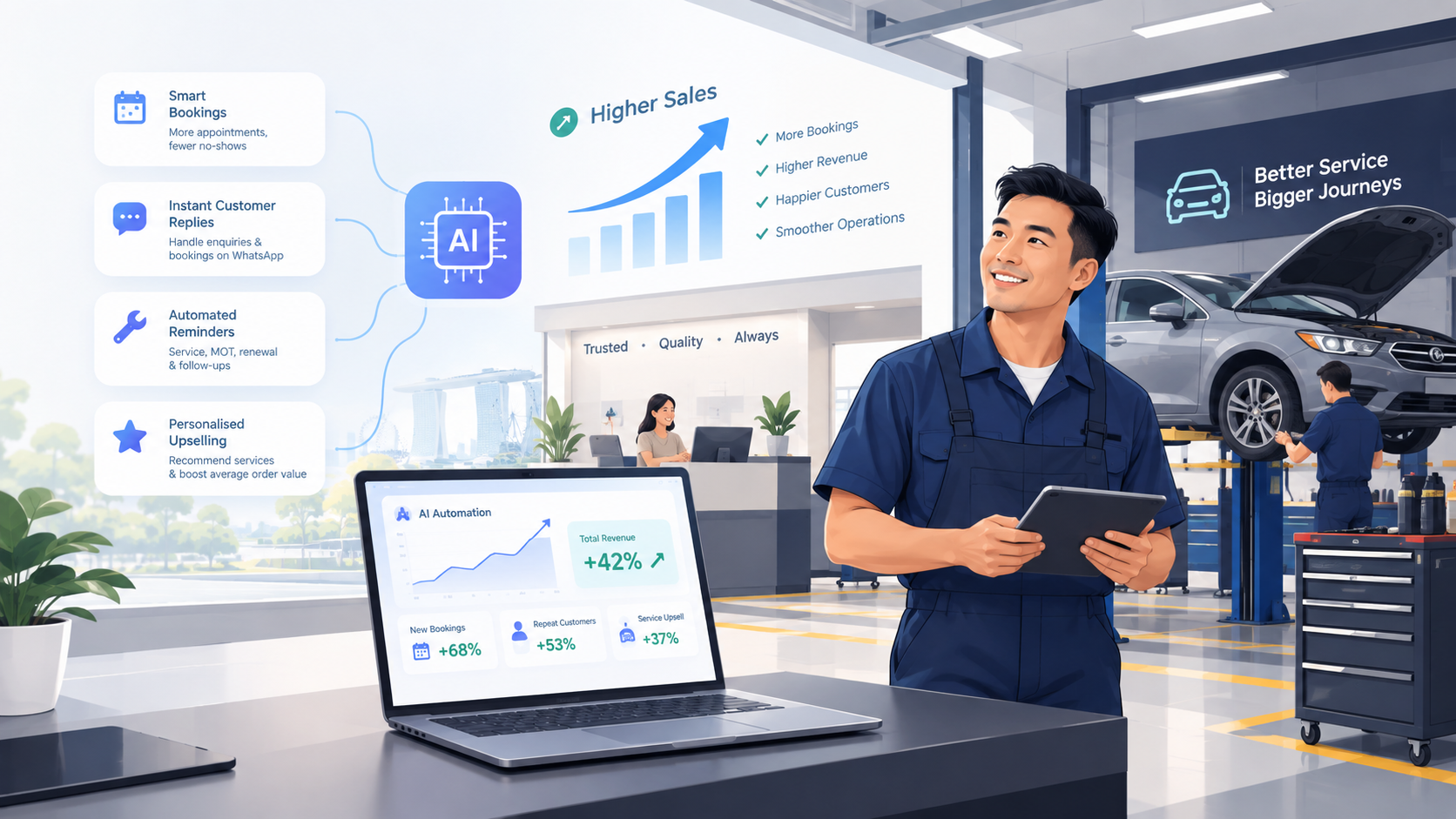
    AI automation for an auto workshop is a set of connected systems that handle the repetitive front-desk and back-office work around servicing a car — booking intake, appointment reminders, job status updates, quote approvals, parts reordering, and fleet-account communication — without a service advisor manually doing each step by phone or WhatsApp.

    Two layers are worth separating:

    • Workflow automation follows fixed rules. A customer messages the workshop’s WhatsApp number, so an AI agent checks the booking calendar, offers open slots, confirms the appointment, and sends a reminder the evening before. No human touches any of those steps.
    • Agentic AI handles judgment calls inside guardrails. A customer describes a noise the car is making; the assistant asks clarifying questions, flags it as a possible brake issue, and books the right service bay and duration — then hands off to a mechanic for anything outside its rules, such as price negotiation or a warranty dispute.

    Most workshops start with workflow automation on booking and reminders, then add agentic capability once the first layer is proven.

    Why this matters for Singapore workshops specifically

    Market reality What it means for a workshop
    Car population flat at ~660,000 since 2018; private cars have declined since 2022 No fleet growth to ride — growth has to come from winning a larger share of a fixed pool of cars, not a bigger pool
    ~2,583 repair establishments, rising ~5% a year More competitors chasing the same flat demand — price alone is a losing strategy since independents already undercut dealers by design
    EVs were 45.1% of new car registrations in 2025, up from 3.8% in 2021 Routine ICE servicing volume shrinks over the next decade as the fleet turns over; workshops need to capture higher-value work (ADAS calibration, EV/HV servicing, fleet contracts) to offset it
    Motorcars are consistently among Singapore’s most-complained-about consumer categories (CASE, 2024) Trust is scarce and valuable — transparent, automated communication is a real differentiator, not just a convenience feature
    Fleet and private-hire servicing is the fastest-growing customer segment B2B accounts need reliable status updates and invoicing at volume — a good fit for automation, a poor fit for manual phone calls

    Where AI automation actually helps in a workshop

    Pain point What AI automation does
    Front desk tied up answering “got slot or not” messages all day WhatsApp booking assistant shows live availability and confirms appointments 24/7, including outside opening hours
    Customers who no-show or forget appointments Automated reminders the day before and morning of — workshops using this pattern typically cut no-shows meaningfully
    Customers anxious about being overcharged or not knowing what’s happening to their car Automated job-status updates with photos of the actual worn part, itemised digital quotes sent for approval before work starts
    Parts reordering handled reactively, causing delays mid-job Inventory automation flags low stock and triggers reorders against historical usage patterns
    Fleet/private-hire accounts calling in for status on multiple vehicles A dedicated fleet portal or WhatsApp channel with automated status pushes per vehicle, batch invoicing
    Manual data entry between the booking system, the invoicing tool, and the accountant Systems talk to each other — a completed job automatically triggers an invoice and updates the customer’s digital service record

    The trust angle: automation as a differentiator, not just an efficiency play

    Only around 27 motoring businesses in Singapore hold CaseTrust-SVTA accreditation — the formal mark of standard contracts, itemised pricing, and bonded dispute resolution. That scarcity is the opening. A workshop that automatically sends a photo of the worn part before repair, an itemised digital quote before work starts, and a written service record after completion is doing, by default, most of what CaseTrust accreditation exists to prove — and doing it for every customer without extra admin headcount.

    This also touches the Personal Data Protection Act (PDPA): a workshop’s booking and CRM systems hold customers’ names, phone numbers, vehicle registration numbers, and service history. Any automation vendor should be able to state plainly where that data is stored, who can access it, and how long it is retained — the same standard Stack AI applies to every client system.

    Government grants that can fund this

    Grant Funding Fit for a workshop
    Productivity Solutions Grant (PSG) Up to 50% co-funding, S$30,000 annual cap Covers pre-approved productivity IT solutions from the GoBusiness Tech Depot — workshop management systems, customer communication tools, and accounting/inventory software all have pre-approved options
    Enterprise Development Grant (EDG) Up to 50% co-funding Best fit for a custom-built automation project (e.g. a bespoke WhatsApp booking + fleet-portal system) rather than an off-the-shelf PSG solution, since EDG funds broader business/process transformation projects

    Standard eligibility for both applies as with any Singapore SME: the business must be registered and operating in Singapore, with at least 30% local shareholding. Workshops of any size that meet these criteria can apply — there is no automotive-specific exclusion. Apply before signing any vendor contract; retroactive funding is not available.

    Not sure where to start?

    Stack AI scopes a free assessment of your workshop’s booking, communication, and back-office workflows — and tells you honestly which parts are worth automating first.

    Book a free assessment

    How a rollout typically works

    1. Free workflow assessment. We map how bookings, reminders, quotes, and parts ordering currently happen — phone, WhatsApp, paper, spreadsheets — and flag where the busiest manual bottlenecks are.
    2. Scope the first system. Most workshops start with WhatsApp booking and reminders, since it touches every customer and shows results within weeks.
    3. Build and connect. The automation is built to work with (not replace) whatever booking or accounting software the workshop already uses, wherever practical.
    4. Run alongside existing operations. New bookings route through the system while walk-ins and phone bookings continue as normal — no forced cutover on a busy floor.
    5. Expand once proven. Once booking and reminders are working, add digital quotes, fleet-account automation, or inventory triggers based on what the workshop actually needs.
    6. Handover and support. Staff are trained to monitor and adjust the system themselves, with support on call for anything more complex.

    Frequently asked questions

    Will AI automation replace my mechanics or service advisors?

    No. It replaces repetitive coordination work — answering “got slot or not,” typing the same reminder message, chasing a customer for approval on a quote — so your staff can spend more time on cars and on customers who need a real conversation, such as a warranty dispute or a price negotiation.

    My workshop still runs mostly on WhatsApp and a paper diary. Can this still work for us?

    Yes — WhatsApp is usually the starting point, not something to replace. The automation sits on top of your existing WhatsApp Business number and calendar, so customers keep messaging the same number they already have saved.

    Does this help with the shift toward EV and ADAS work?

    Indirectly. Automation doesn’t teach a technician EV or ADAS skills, but it frees up the front-desk and admin time needed to build those higher-value service lines — and a clean digital service record is exactly what a fleet or insurer wants to see before trusting a workshop with EV/HV or ADAS calibration work.

    How much does this typically cost?

    A single workflow, such as WhatsApp booking and reminders, typically runs S$3,000–S$8,000 to build. A fuller front-of-house system covering quotes, job-status updates, and parts triggers is typically S$10,000–S$25,000. These are scope-dependent estimates, not fixed quotes — a free assessment gives you an exact number for your workshop, and PSG/EDG co-funding can offset up to half of it.

    What data does an automation system store, and is it PDPA-compliant?

    Typically customer name, phone number, vehicle registration, and service history — the same data most workshops already hold in a booking diary or CRM. Stack AI builds every system with a clear data-retention and access policy in line with PDPA, and can walk through exactly where the data sits before any project starts.